
Tibetan Buddhist Chant
Tibetan monastic chanting built on a sub-bass overtone voice that lets a single monk sound two pitches at once.
What it sounds like
Tibetan monastic chant is sung by men in an exceptionally low register, the defining technique being dzo-ke or 'deep voice' overtone singing — a single chanter can sound a fundamental in the basement of the bass range while a flute-like overtone hovers above it. When dozens of monks chant together the overtones tangle and thicken into a dense, slow harmonic field. Long brass dungchen horns, the nga drum and the rolmo cymbals enter at ritual junctures and frame the chant. Tempo is glacial; a single syllable can run for several seconds.
How it came about
Tibetan ritual chanting took shape after Buddhism arrived from India during the Tibetan Empire of the 7th–9th centuries, then branched into distinct school repertoires — Gelug, Kagyu, Nyingma, Sakya — each with its own vocal techniques. After the Dalai Lama's 1959 exile, monks gathered around Dharamsala in northern India and put significant energy into preserving the lineages. The Gyuto Tantric Choir, who carry the Gelug Gyuto college's repertoire, became the international face of the tradition; their 1989 recordings reached an audience well outside Buddhism.
What to listen for
Once your ear adjusts to the low fundamental, listen for the high whistle that floats above it — that's the overtone. With a full choir, the overtones from different singers don't line up exactly, which is what produces the moving, beating texture. Treat the horns and drums as architecture, not as beats.
If you only hear one thing
The Gyuto Tantric Choir's 'Mahakala Puja' (1995) walks through enough of a ritual sequence to show how chant, horns and percussion fit together. Listen at low light, with the bass turned up enough that the floor moves.
Trivia
Tibetan overtone chant — one monk producing two audible pitches simultaneously — was so unexpected to Western acoustic researchers that early analysts reportedly suspected equipment failure. It shares family resemblance with Tuvan and Mongolian khoomei, but is pitched lower and is liturgical rather than secular.
Notable artists
- Gyütö Tantric Choir
Notable tracks
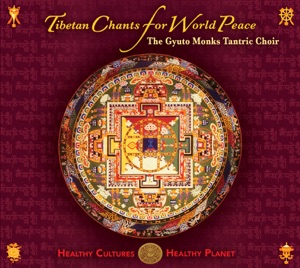 Gyütö Tantric Choir — Gyütö Tantric Choir Live (1989)
- Gyütö Tantric Choir — Mahakala Puja (1995)